
Senegalese Thiéboudienne - West African Fish & Rice Recipe
Senegalese Thiéboudienne - West African Fish & Rice Recipe


- Serves: 6 People
- Prepare Time: 45 minutes
- Cooking Time: 1 hour 30 m
- Calories: -
- Difficulty: Medium
Get ready to embark on a culinary journey to West Africa with the ultimate guide to Authentic Senegalese Thiéboudienne! This isn't just any `african cuisine recipe`; it's Senegal's national dish, a vibrant, one-pot feast of stuffed fish, rich tomato broth, tender vegetables, and perfectly cooked broken rice. Often called ceebu jen or thiebou dieune (pronounced "cheh-boo-jen"), Thiéboudienne is a testament to the incredible `food and cultures` found around the world, blending simple ingredients into a complex symphony of flavors.
Forget bland or complicated cooking – we're stripping away the mystery and bringing you a truly authentic version of this `West African cuisine` staple, made entirely doable in your home kitchen. While there are many family variations, this guide focuses on one canonical recipe that delivers the heart and soul of traditional Senegalese cooking. You'll learn the secrets to the herby `fish marinade recipe` (the "rof"), the tangy balance of tamarind, and the satisfying umami that makes this `african dish recipe` truly special. Dive in and discover why Thiéboudienne is more than just a meal; it's a celebration!
This comprehensive guide is designed to answer all your cravings and questions about this iconic dish:
Find an authentic Thiéboudienne recipe: We provide the main, canonical version, ensuring a true taste of Senegal.
Learn the traditional stuffed-fish-and-rice method step by step: From preparing the rof to creating the crispy rice (xooñ), every detail is covered.
Discover the key ingredients: Unpack the importance of rof, broken rice, tamarind, nététou (or dried fish), and the classic vegetable mix.
Explore the flavor profile of Senegalese cuisine: Understand how these elements combine to create a uniquely balanced and savory experience.
Understand how this dish fits into everyday and celebratory life in Senegal: Get a glimpse into the cultural significance of this beloved `african dish recipe`.
Ingredients
Directions
- Make the Rof (Herb Stuffing)
- In a mortar and pestle (for best traditional texture) or a food processor, combine the parsley, garlic, onion/scallions, Scotch bonnet peppers, bouillon powder (or nététou powder), black pepper, and salt.
- Pound or pulse until you have a coarse, vibrant green paste. It shouldn't be a smooth purée; you want some texture.
- Reserve about 1/4 cup of this rof for later use in the broth. This is the heart of your `fish marinade recipe` and flavor base.
- Stuff and Season the Fish
- If using a whole fish, score 2-3 deep slits into each side of the fish with a sharp knife. If using steaks, simply make a few shallow cuts.
- Carefully pack the remaining rof mixture into the slits of the fish and into the cavity of a whole fish. Gently rub any excess over the outside.
- Season the fish lightly with extra salt and black pepper. Let it rest for 10-15 minutes while you prepare the pot.
- Fry or Brown the Fish
- Heat 2-3 tablespoons of vegetable oil in a heavy 6-8 quart pot or Dutch oven over medium-high heat.
- Once the oil is shimmering, carefully place the stuffed fish into the hot oil. Fry for 3-5 minutes per side, until beautifully golden brown and slightly crispy. The goal is to brown the skin and seal in the flavors, not to cook it through. This browning prevents the fish from falling apart later.
- Carefully remove the browned fish from the pot and set it aside on a plate.
- Build the Tomato–Tamarind Broth
- In the same pot with the remaining oil (add a little more if needed), add the chopped onions. Cook over medium heat, stirring occasionally, until the onions are translucent and softened, about 8-10 minutes.
- Add the entire can of tomato paste to the pot. Stir constantly and cook the tomato paste for 10-15 minutes, allowing it to brown and deepen in color (it should turn a rich brick red). This step is crucial for developing the `tomato sauce recipe`'s flavor and removing any raw tomato taste.
- Stir in the reserved 1/4 cup of rof, the nététou powder or flaked dried fish (if using), and the tamarind paste. Cook for another 2-3 minutes, letting the flavors meld.
- Pour in 6-8 cups of water or stock. Bring the mixture to a simmer.
- Season the broth generously with salt and black pepper. Taste and adjust seasonings – it should be robust and flavorful, as this will season the vegetables and rice. If using whole chiles, add them now to infuse mild heat.
- Cook the Vegetables in Layers
- Add the tougher vegetables first: carrots, cassava/turnip, and sweet potato (if using). Simmer in the broth for about 15-20 minutes, until they begin to soften.
- Next, add the medium-tender vegetables: eggplant and cabbage. Continue simmering for another 10-15 minutes.
- Finally, add the quick-cooking okra. Simmer for just 5-7 minutes more, until all vegetables are tender but not mushy.
- Using a slotted spoon, carefully remove all the cooked vegetables from the broth and place them in a large bowl. Cover the bowl to keep them warm.
- Simmer the Fish in the Sauce
- Gently return the browned fish to the simmering broth. Ensure it’s mostly submerged.
- Simmer the fish in the sauce for about 10-15 minutes, depending on its thickness. The goal is to finish cooking the fish and allow it to absorb the broth's flavors without overcooking or falling apart.
- Carefully remove the cooked fish from the pot and add it to the bowl with the vegetables, covering to keep warm.
- Prepare and Cook the Rice in the Broth
- Thoroughly rinse the broken rice under cold water until the water runs clear. Drain it very well. This prevents mushy rice.
- Measure out 5-6 cups of the remaining broth from the pot. If you have less, add water or stock to reach the necessary volume. (Note: broken rice generally requires less liquid than long-grain rice, so start with 5 cups and add more if needed).
- Bring the broth to a rolling boil. Add the rinsed and drained rice, stirring once to distribute.
- Once it returns to a boil, reduce the heat to the lowest setting, cover the pot tightly, and cook for 20-25 minutes. Do not lift the lid during this time.
- After 20-25 minutes, check for doneness. The grains should be tender but separate, the liquid absorbed, and small steam holes visible on the surface. If still too wet, cover and cook for a few more minutes. If too dry, add a splash of hot water, cover, and cook briefly.
- Create and Handle the Crunchy Rice (Xooñ)
- After the rice is cooked, if you desire the prized crispy bottom layer (xooñ), leave the pot on very low heat, uncovered, for an additional 10-15 minutes. Listen for a gentle crackling sound. Be careful not to burn it.
- Once done, turn off the heat. Use a sturdy spatula to carefully loosen the xooñ from the bottom of the pot, breaking it into pieces. This crunchy rice is considered a delicacy!
- Assemble and Serve
- On a large, traditional communal platter (or individual plates), mound the fluffy rice in the center.
- Arrange the cooked vegetables around the rice.
- Place the fish on top of the rice or alongside the vegetables.
- Garnish with fresh lime wedges and chopped parsley/cilantro, if desired. Serve pieces of xooñ alongside.
- Thiéboudienne is traditionally eaten communally, with everyone sharing from the same platter. For smaller households, portioning into individual bowls works perfectly.
Senegalese Thiéboudienne - West African Fish & Rice Recipe
- Serves: 6 People
- Prepare Time: 45 minutes
- Cooking Time: 1 hour 30 m
- Calories: -
- Difficulty: Medium
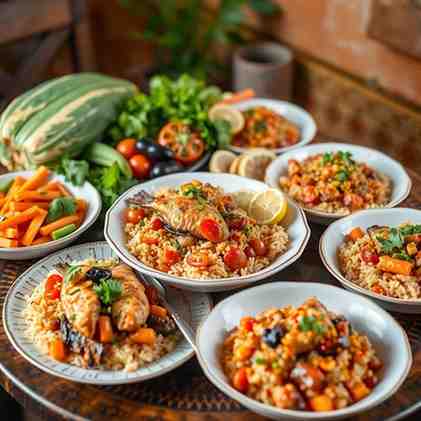
Get ready to embark on a culinary journey to West Africa with the ultimate guide to Authentic Senegalese Thiéboudienne! This isn't just any `african cuisine recipe`; it's Senegal's national dish, a vibrant, one-pot feast of stuffed fish, rich tomato broth, tender vegetables, and perfectly cooked broken rice. Often called ceebu jen or thiebou dieune (pronounced "cheh-boo-jen"), Thiéboudienne is a testament to the incredible `food and cultures` found around the world, blending simple ingredients into a complex symphony of flavors.
Forget bland or complicated cooking – we're stripping away the mystery and bringing you a truly authentic version of this `West African cuisine` staple, made entirely doable in your home kitchen. While there are many family variations, this guide focuses on one canonical recipe that delivers the heart and soul of traditional Senegalese cooking. You'll learn the secrets to the herby `fish marinade recipe` (the "rof"), the tangy balance of tamarind, and the satisfying umami that makes this `african dish recipe` truly special. Dive in and discover why Thiéboudienne is more than just a meal; it's a celebration!
This comprehensive guide is designed to answer all your cravings and questions about this iconic dish:
Find an authentic Thiéboudienne recipe: We provide the main, canonical version, ensuring a true taste of Senegal.
Learn the traditional stuffed-fish-and-rice method step by step: From preparing the rof to creating the crispy rice (xooñ), every detail is covered.
Discover the key ingredients: Unpack the importance of rof, broken rice, tamarind, nététou (or dried fish), and the classic vegetable mix.
Explore the flavor profile of Senegalese cuisine: Understand how these elements combine to create a uniquely balanced and savory experience.
Understand how this dish fits into everyday and celebratory life in Senegal: Get a glimpse into the cultural significance of this beloved `african dish recipe`.
Ingredients
Directions
- Make the Rof (Herb Stuffing)
- In a mortar and pestle (for best traditional texture) or a food processor, combine the parsley, garlic, onion/scallions, Scotch bonnet peppers, bouillon powder (or nététou powder), black pepper, and salt.
- Pound or pulse until you have a coarse, vibrant green paste. It shouldn't be a smooth purée; you want some texture.
- Reserve about 1/4 cup of this rof for later use in the broth. This is the heart of your `fish marinade recipe` and flavor base.
- Stuff and Season the Fish
- If using a whole fish, score 2-3 deep slits into each side of the fish with a sharp knife. If using steaks, simply make a few shallow cuts.
- Carefully pack the remaining rof mixture into the slits of the fish and into the cavity of a whole fish. Gently rub any excess over the outside.
- Season the fish lightly with extra salt and black pepper. Let it rest for 10-15 minutes while you prepare the pot.
- Fry or Brown the Fish
- Heat 2-3 tablespoons of vegetable oil in a heavy 6-8 quart pot or Dutch oven over medium-high heat.
- Once the oil is shimmering, carefully place the stuffed fish into the hot oil. Fry for 3-5 minutes per side, until beautifully golden brown and slightly crispy. The goal is to brown the skin and seal in the flavors, not to cook it through. This browning prevents the fish from falling apart later.
- Carefully remove the browned fish from the pot and set it aside on a plate.
- Build the Tomato–Tamarind Broth
- In the same pot with the remaining oil (add a little more if needed), add the chopped onions. Cook over medium heat, stirring occasionally, until the onions are translucent and softened, about 8-10 minutes.
- Add the entire can of tomato paste to the pot. Stir constantly and cook the tomato paste for 10-15 minutes, allowing it to brown and deepen in color (it should turn a rich brick red). This step is crucial for developing the `tomato sauce recipe`'s flavor and removing any raw tomato taste.
- Stir in the reserved 1/4 cup of rof, the nététou powder or flaked dried fish (if using), and the tamarind paste. Cook for another 2-3 minutes, letting the flavors meld.
- Pour in 6-8 cups of water or stock. Bring the mixture to a simmer.
- Season the broth generously with salt and black pepper. Taste and adjust seasonings – it should be robust and flavorful, as this will season the vegetables and rice. If using whole chiles, add them now to infuse mild heat.
- Cook the Vegetables in Layers
- Add the tougher vegetables first: carrots, cassava/turnip, and sweet potato (if using). Simmer in the broth for about 15-20 minutes, until they begin to soften.
- Next, add the medium-tender vegetables: eggplant and cabbage. Continue simmering for another 10-15 minutes.
- Finally, add the quick-cooking okra. Simmer for just 5-7 minutes more, until all vegetables are tender but not mushy.
- Using a slotted spoon, carefully remove all the cooked vegetables from the broth and place them in a large bowl. Cover the bowl to keep them warm.
- Simmer the Fish in the Sauce
- Gently return the browned fish to the simmering broth. Ensure it’s mostly submerged.
- Simmer the fish in the sauce for about 10-15 minutes, depending on its thickness. The goal is to finish cooking the fish and allow it to absorb the broth's flavors without overcooking or falling apart.
- Carefully remove the cooked fish from the pot and add it to the bowl with the vegetables, covering to keep warm.
- Prepare and Cook the Rice in the Broth
- Thoroughly rinse the broken rice under cold water until the water runs clear. Drain it very well. This prevents mushy rice.
- Measure out 5-6 cups of the remaining broth from the pot. If you have less, add water or stock to reach the necessary volume. (Note: broken rice generally requires less liquid than long-grain rice, so start with 5 cups and add more if needed).
- Bring the broth to a rolling boil. Add the rinsed and drained rice, stirring once to distribute.
- Once it returns to a boil, reduce the heat to the lowest setting, cover the pot tightly, and cook for 20-25 minutes. Do not lift the lid during this time.
- After 20-25 minutes, check for doneness. The grains should be tender but separate, the liquid absorbed, and small steam holes visible on the surface. If still too wet, cover and cook for a few more minutes. If too dry, add a splash of hot water, cover, and cook briefly.
- Create and Handle the Crunchy Rice (Xooñ)
- After the rice is cooked, if you desire the prized crispy bottom layer (xooñ), leave the pot on very low heat, uncovered, for an additional 10-15 minutes. Listen for a gentle crackling sound. Be careful not to burn it.
- Once done, turn off the heat. Use a sturdy spatula to carefully loosen the xooñ from the bottom of the pot, breaking it into pieces. This crunchy rice is considered a delicacy!
- Assemble and Serve
- On a large, traditional communal platter (or individual plates), mound the fluffy rice in the center.
- Arrange the cooked vegetables around the rice.
- Place the fish on top of the rice or alongside the vegetables.
- Garnish with fresh lime wedges and chopped parsley/cilantro, if desired. Serve pieces of xooñ alongside.
- Thiéboudienne is traditionally eaten communally, with everyone sharing from the same platter. For smaller households, portioning into individual bowls works perfectly.
You may also like



Hey there! I’m just someone who seriously loves good food and believes that cooking doesn’t have to be complicated to be amazing. Whether it’s a quick weeknight dinner or a cozy weekend meal, I’m all about sharing easy, tasty recipes that actually work.